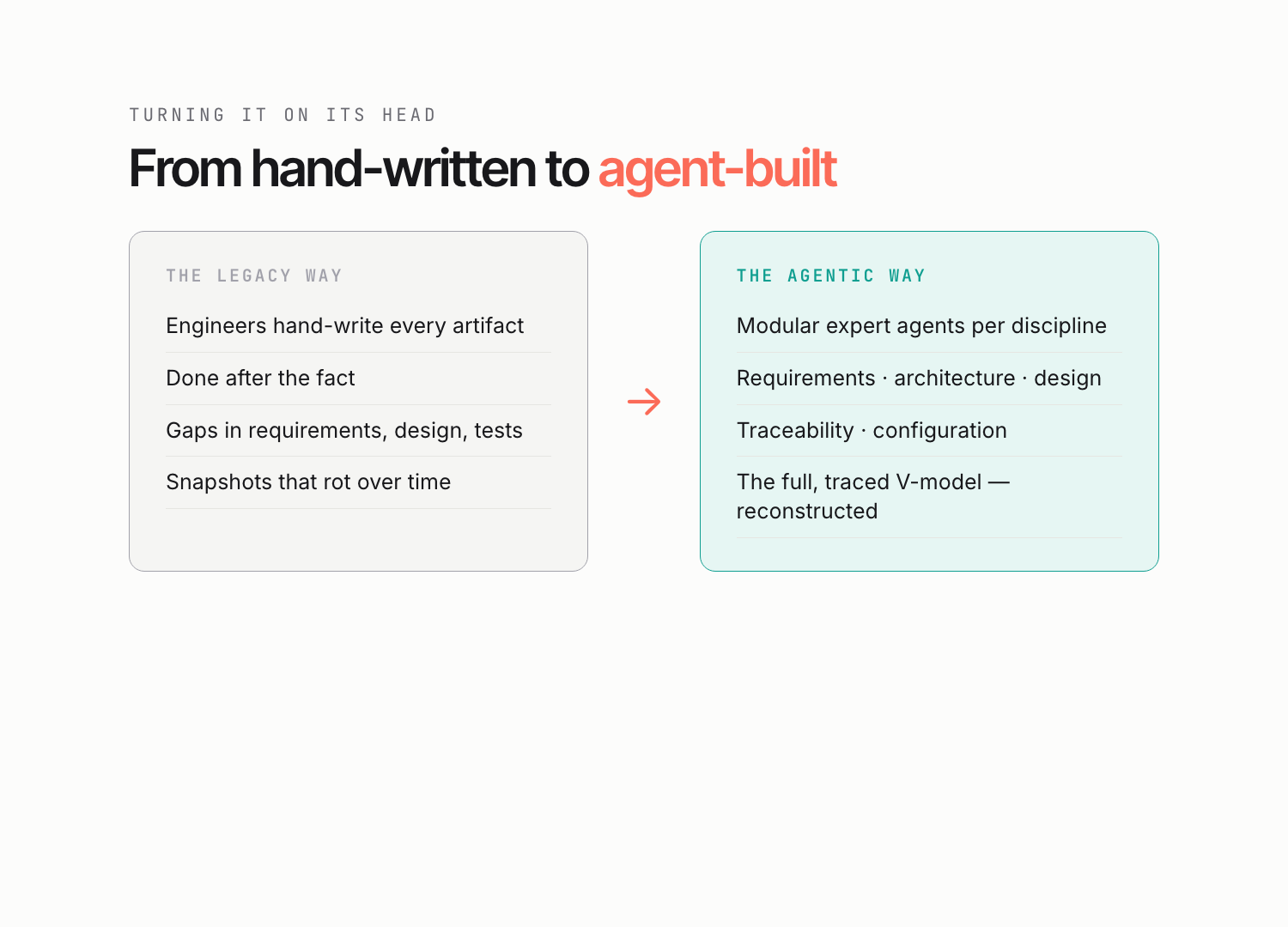
Stop hand-writing evidence after the fact. A team of modular AI agents reconstructs the full, traced ASPICE V-model from your code and your intent — with a confidence score and audit trail on every decision.
AI agents automate ASPICE compliance by generating assessment-ready work products — traceability records, review records, test specifications — as a byproduct of normal engineering work. A team of modular agents (requirements, architecture, design, traceability, configuration) reconstructs the full, traced V-model from engineering intent (commits, pull requests, comments, user stories), attaches a confidence score and audit trail to every decision, and routes anything below threshold to a human. It does not replace the assessor or your process ownership — it removes the manual evidence production teams fail on.
Every automotive supplier feels the same squeeze: ship at software speed, but also produce an OEM-auditable ASPICE evidence trail. Done the legacy way those two goals fight each other. AI agents are how you stop them fighting.
Engineers spend more than 80% of their time on work that isn't code: writing user stories, tracing requirements, sitting in review meetings, hunting for the one document where an architectural change was recorded, hand-syncing the same change across DOORS, Codebeamer, Jira, Confluence, and email. For every one engineer doing the work, you need another to document it. A ten-minute code change takes two to four weeks to land, and the true cost runs to roughly ten times the cost of the code.
And most of that evidence — change records, review records, communication records — is 1990s pen-and-paper artifacts that already exist automatically inside your tools, laboriously recreated as Excel sheets and signed PDFs. (We unpack why in what ASPICE actually is — and is not.)
Here's the legacy way: engineers hand-write requirements, architecture, design, and traceability — usually after the fact, with gaps everywhere. The new way flips it. You deploy a team of modular AI agents — requirements, architecture, design, traceability, configuration — that reconstruct the full, traced V-model for you, from what your engineers already produced.
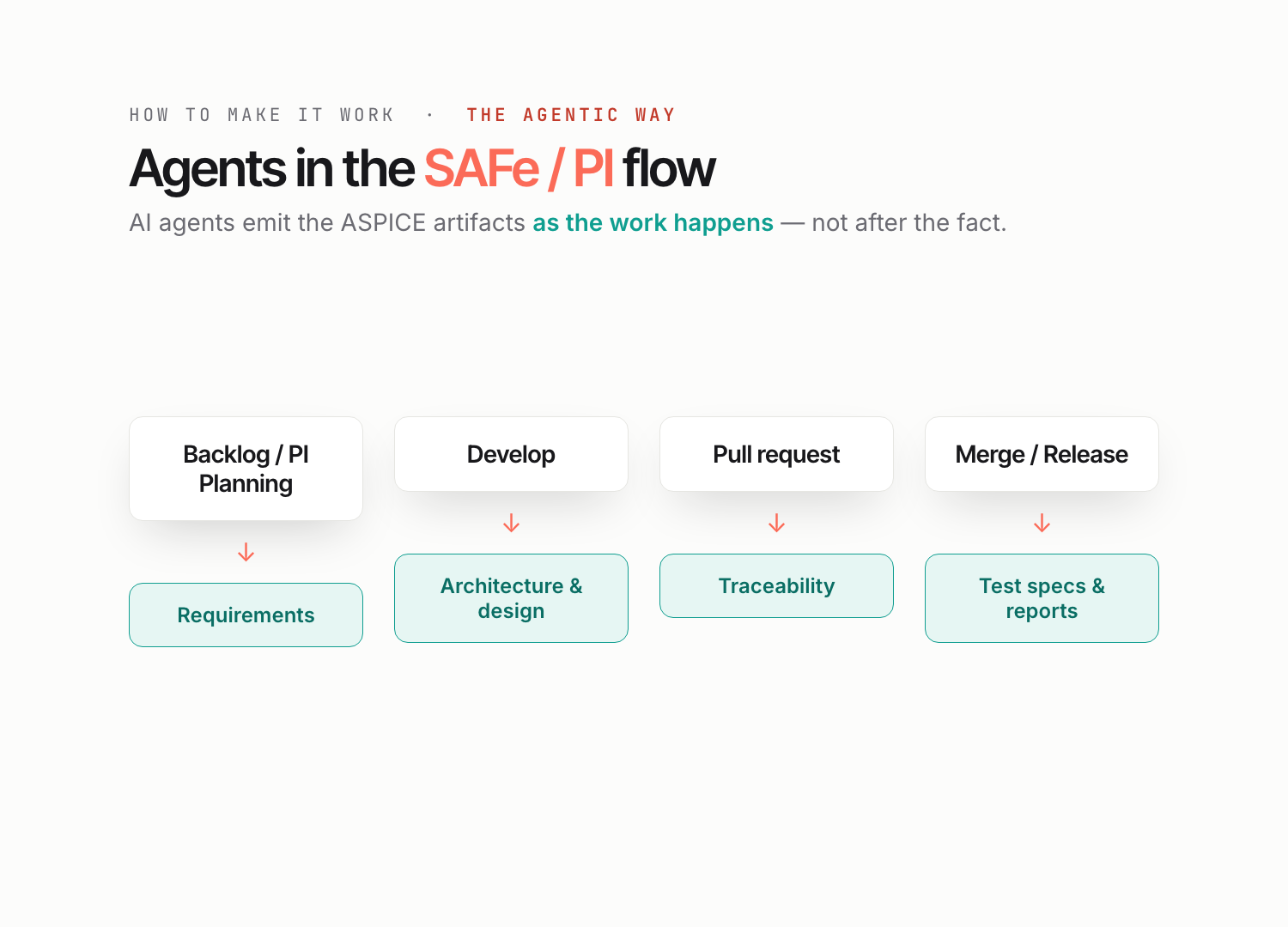
The real trick isn't reading code. It's reading intent. Commit messages, code comments, pull requests, user stories — they carry what your engineers actually meant. The agents prioritize that intent, hypothesize the design, and test it in loops, reconstructing the boundaries the code was built within. When they can't, they flag it rather than guess.
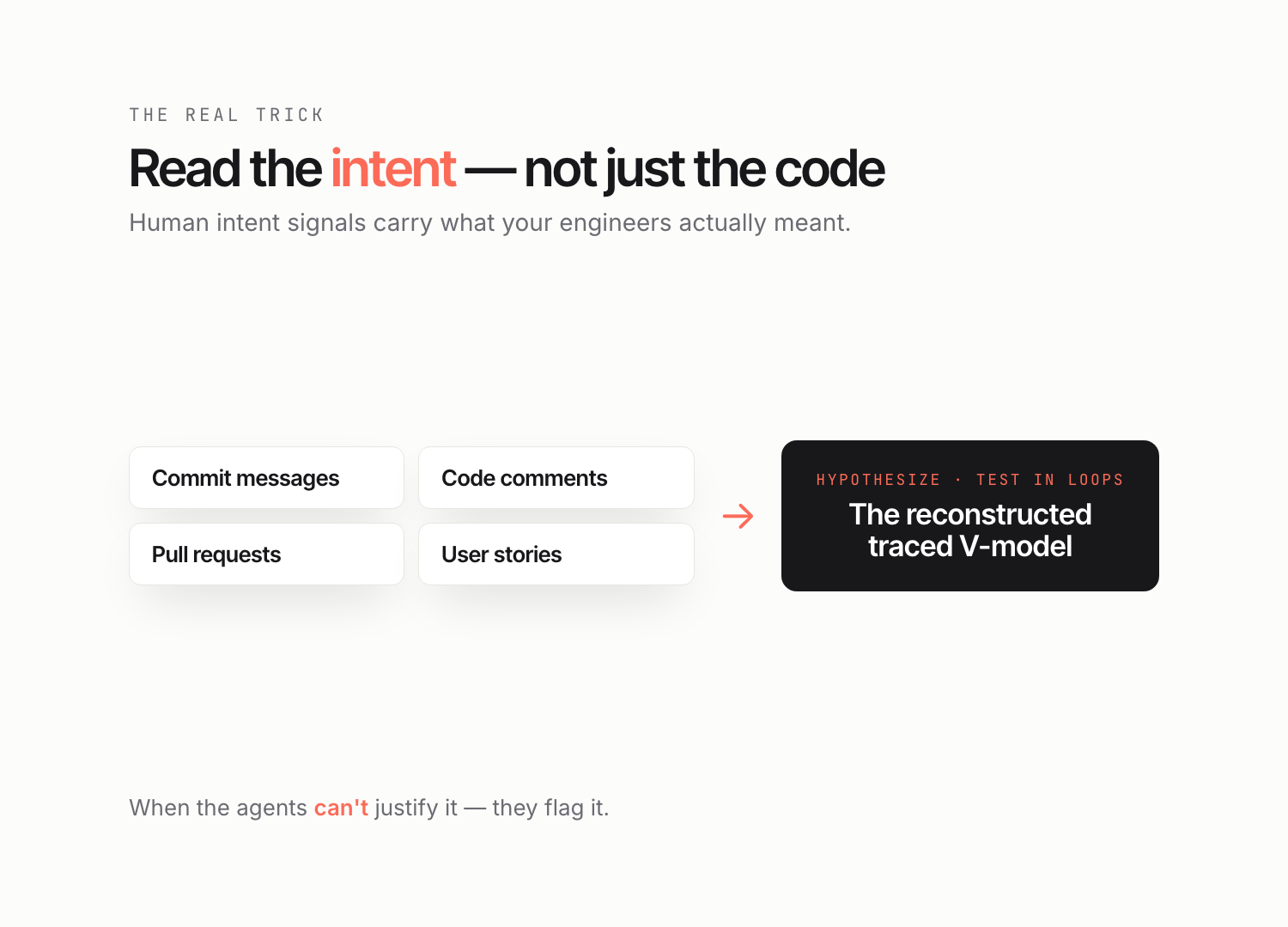
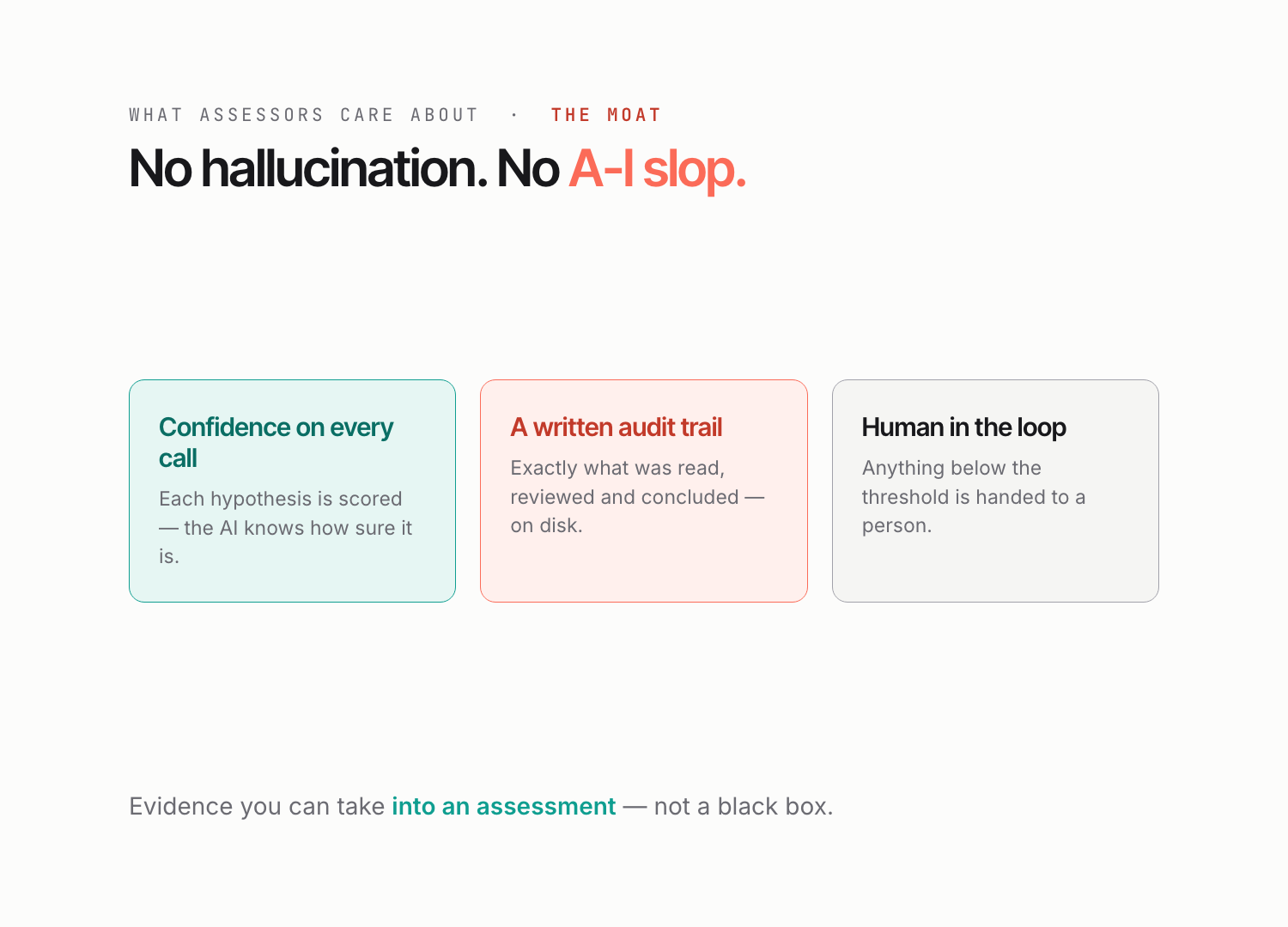
This is the difference between real evidence and “ChatGPT wrote our docs.” Every decision an agent makes carries a confidence score and an audit trail — exactly what was read, reviewed, and concluded, written down. Anything below threshold goes to a human. No hallucination, no AI slop: evidence you can take into an assessment.
“No hallucination, no AI slop — evidence you can take into an assessment.”The honesty framework
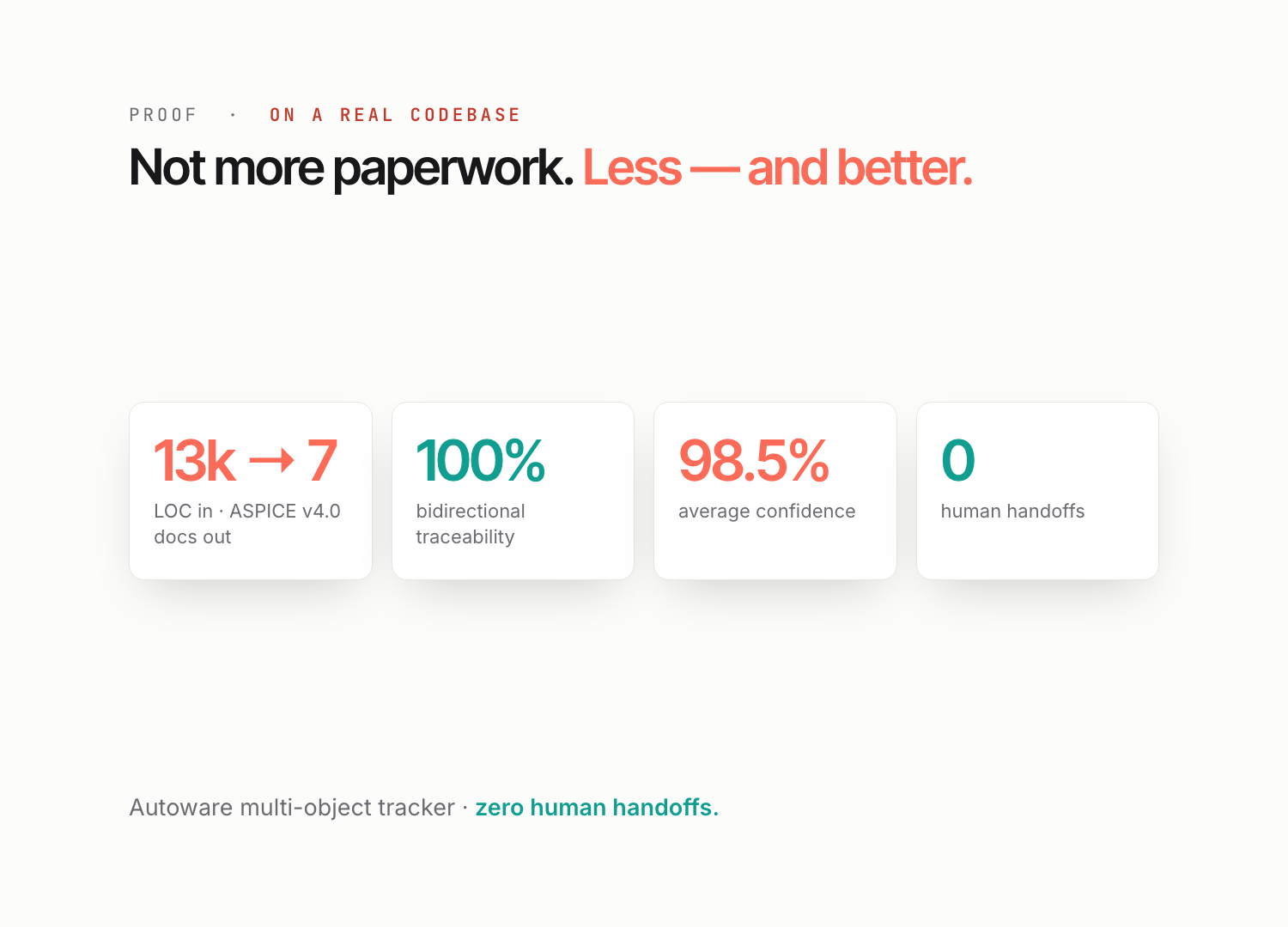
This isn't a concept slide. On a real autonomous-driving codebase (Autoware Universe), the agents produced a complete, traced ASPICE work-product set:
— with zero human handoffs in the run. Full bidirectional traceability (SYS.2 → SWE.1 → SWE.3 → SWE.4 → SWE.6) generated, not hand-linked.
The one-shot version is useful; the continuous version changes the game. Wire the agents into your CI/CD pipeline, and on every pull request they run the end-to-end change analysis — requirements impact, architecture, design, test cascade — and post it back for a human to approve. Compliance stops being a project you do before SOP. It becomes continuous. This is the same context problem that hobbles AI coding agents in automotive, solved from the compliance side.
“Compliance stops being a project. It becomes continuous.”On CI/CD-native ASPICE
Vera is your ASPICE engineer that lives inside your organization — so your ASPICE documentation works for you, instead of your engineers working for the documentation. A consultant is capped by billable hours; agents are not. And unlike a body-shop of process people, Vera doesn't add headcount to describe the work — it makes the evidence exist. That's the thing suppliers actually ask for: “we don't want more process people, we want the evidence to exist.”
Yes. The newest category of ASPICE tooling generates assessment-ready work products — traceability records, review evidence, test specifications — as a byproduct of normal engineering work, each with an audit trail. It removes most of the manual evidence production teams fail on, without replacing the assessor or your process ownership.
Not when the evidence holds up. Each artifact carries a confidence score and an audit trail showing exactly what was read, reviewed, and concluded. Anything below threshold is escalated to a human. That verifiable trail is the difference between assessment-ready evidence and 'ChatGPT wrote our docs'.
No. It automates the production of the work products and traceability your process requires. Your process ownership, your reviews, and your assessment stay yours — the agents just stop you from producing all of it by hand, late and with gaps.
They read intent — commits, pull requests, comments, user stories — hypothesize the design, and test it in loops to reconstruct the boundaries the code was built within. Links are generated with a confidence score; low-confidence links are flagged for a human rather than guessed.
Yes. Wired into the pipeline, the agents run an end-to-end change analysis on every pull request (requirements impact, architecture, design, test cascade) and post it for human approval, so the evidence stays current instead of being reconstructed before an assessment.
Grounded in the standard, honest about the theater: What is ASPICE · ASPICE vs CMMI · Agile ASPICE · Best ASPICE tools