SUP.8 isn't a sidecar process. It's the configuration-management data model that every other process area is quietly capped by — and the reason ASPICE maturity needs a headless ALM plus an agent/human workflow and trace platform.
In ASPICE, SUP.8 Configuration Management is the enabling layer: the shared data model of configuration items, versions, baselines and bidirectional links that every other process area depends on. No process — SYS, SWE, SUP, MAN — can reach a mature capability level (CL2+) beyond the maturity of the CM data model underneath it. Making that data model real, and usable by both humans and AI agents, needs a headless ALM (an API-first, tool-agnostic single source of truth for every work product and link) plus an agent/human workflow definition, coordination and traceability platform on top of it.
Everyone treats configuration management as plumbing — a box you tick, a tool the CM manager owns. That's backwards. Get this one right and every other process becomes provable. Get it wrong and no amount of process ceremony saves you.
ASPICE lists SUP.8 Configuration Management among the supporting processes, which makes it look optional or peripheral. In reality it is load-bearing. Every requirement, every architecture element, every test case, every review record, every change — all of it is a configuration item with an identity, a version, a place in a baseline, and links to other items. That web is your ASPICE evidence. SUP.8 is the process that keeps the web coherent.
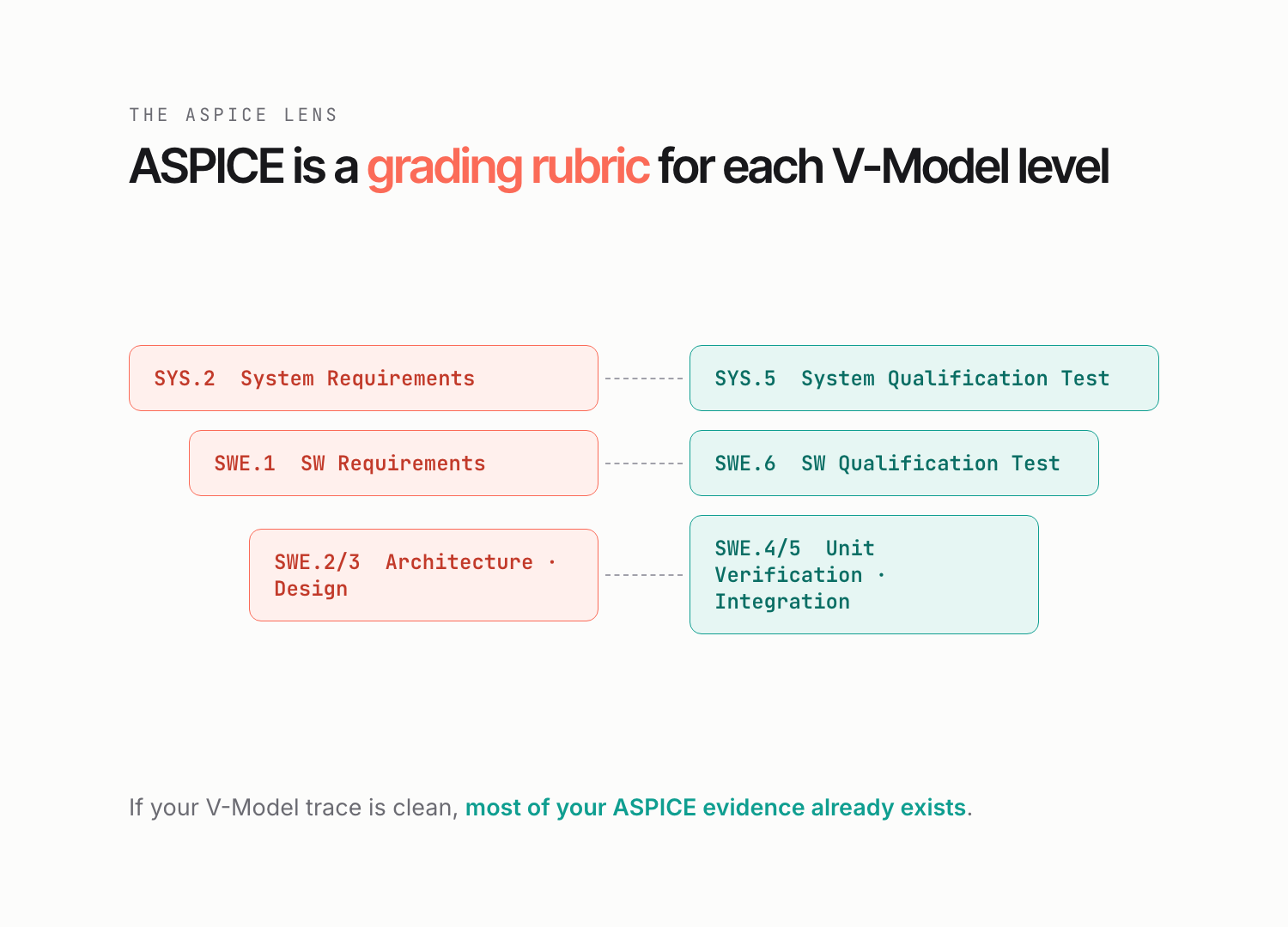
Strip ASPICE down and underneath every process is one data model: items (requirements, architecture, design, tests, change requests, problems, reviews), their versions, the baselines that freeze a consistent set at a point in time, and the bidirectional links between them (SYS.2 → SWE.1 → SWE.3 → SWE.4 → SWE.6). Capability Level 2 is, in large part, the demand that this data model is managed — controlled, versioned, consistent — rather than reconstructed before an audit.
This is the point almost everyone misses. The maturity of any process area is bounded by the maturity of the CM data model beneath it. Your SWE.1 requirements can be beautiful, but if their versions and links aren't controlled, SWE.1 isn't CL2. Your tests can be thorough, but if they don't trace to a baselined requirement, SWE.6 isn't CL2. Configuration management is the basis that only allows mature processes across every other group. It is the secret enabling layer.
“The maturity of every ASPICE process is capped by the maturity of the configuration-management data model underneath it. That's the whole game.”The enabling-layer thesis
Here's the structural problem. Requirements live in DOORS or Polarion. Architecture lives in Enterprise Architect. Tasks and changes live in Jira. Reviews and plans live in Confluence. Each tool holds a slice of the data model, with its own item identities and its own idea of a link. There is no single data model — there are five, stitched together by hand and by export. The moment a requirement changes, the hand-maintained links across those tools decay. You don't have a configuration-management data model; you have five of them pretending to be one. (See best ASPICE tools.)
The fix is architectural, not procedural. You need a headless ALM — an API-first, tool-agnostic application-lifecycle-management layer that holds the configuration-management data model as the single source of truth for every work product and every link, and exposes it as a service. Your existing tools become views and editors on top of that model, not five competing copies of it. And because it's API-first, it's readable and writable by agents as well as humans — which is the precondition for automating any of it.
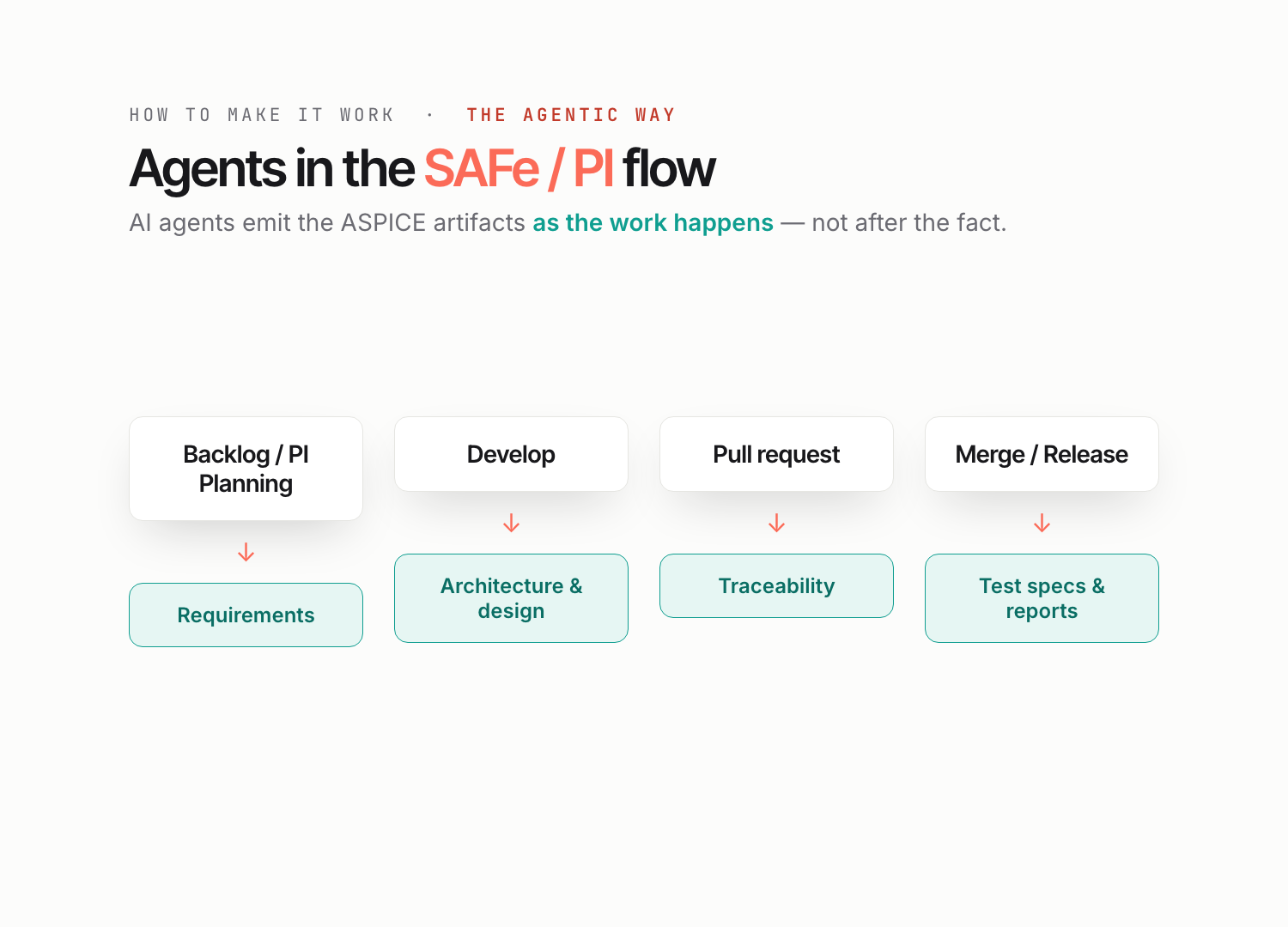
A data model on its own is inert. On top of the headless ALM you need a platform that defines and coordinates the work: who does what — a human or an agent — for each change; how a change flows from requirement impact through architecture, design and test; and a trace of every action written back against the one data model. That's how a change becomes planned, assigned, executed and evidenced continuously — instead of archaeologically reconstructed before an assessment. Wire it into CI and compliance stops being a project. (See Agile ASPICE and automating ASPICE with AI agents.)
Recall the original sin of ASPICE: there is no official blueprint anywhere. The standard grades you against a checklist and refuses to tell you how to build the thing. So we wrote one. The Blueprint is our take at the missing blueprint — a free, open template QMS for ASPICE: every VDA-scope process area, its outcomes and work products, mapped to concrete artifacts in your tools, all grounded in this one configuration-management data model. Take it and implement it yourself, at no cost.
Or have us implement it for you. We bring the agentic solutions — Vera generates the work products and traceability as a byproduct of your build, each with a confidence score and audit trail — running on a partner headless ALM that holds the configuration-management data model. The Blueprint tells you what good looks like; our agents plus a headless ALM make it exist. That's the offer: no hallucination, no AI slop, evidence you can take into an assessment.
Because every ASPICE work product is a configuration item with a version, a baseline and links, and the maturity of every other process is capped by how well that data model is managed. SUP.8 is the enabling layer — get it wrong and no process reaches CL2, however good it looks.
The underlying model of items (requirements, architecture, design, tests, changes, problems, reviews), their versions, the baselines that freeze a consistent set, and the bidirectional links between them. That web of controlled, linked items is your assessment evidence.
A headless ALM is an API-first, tool-agnostic layer that holds the configuration-management data model as a single source of truth, exposed as a service so existing tools become views on it and agents as well as humans can read and write it. It's what stops the data model fragmenting across DOORS, Polarion, Jira, EA and Confluence.
Yes. The Blueprint is our free, open template QMS for ASPICE — every VDA-scope process area mapped to work products and tool artifacts, grounded in the CM data model. You can implement it yourself. We also offer to implement it with our agentic solutions on a partner headless ALM.
Because a headless ALM is API-first, agents can read and write the data model directly — generating work products, maintaining links, and tracing every change against the one model, with confidence scores and audit trails, coordinated with humans through a workflow platform.
Grounded in the standard, honest about the theater: The Blueprint (all process areas) · What is ASPICE · Automating ASPICE with AI agents · Best ASPICE tools